SAP AI Design Pattern Library
A shared interaction framework for AI agents across SAP Commerce.
- Role
- UX and Product Design Intern
- Timeline
- 2026
- For
- SAP
- Status
- Shipped
Overview
18 reusable patterns for how AI agents should behave.
As SAP expands AI across its product ecosystem, teams are designing new agentic experiences through Joule, SAP’s AI copilot, and JouleWork, its integrated AI workspace.
I developed a library of 18 reusable interaction patterns to help designers create experiences that remain predictable, transparent, recoverable, and controllable across products.
Problem
Product teams lacked a shared language for designing consistent agent behaviour.
Teams were working across disconnected flows, documentation, and prototypes. AI agents operate across different products, workflows, and levels of autonomy. Although each experience serves a distinct use case, users still need agents to communicate clearly, handle failures safely, and return control when human judgment is required.
Approach
From fragmented agent concepts to a shared behavioural model.
I reviewed source files for existing Joule and JouleWork mockups across SAP product domains, comparing their behaviours with internal guidance and industry patterns. I organized recurring behaviours and gaps into four categories, then refined the framework through feedback from two lead designers and three engineers.
State Communication
Trust & Transparency
Error & Recovery
Human Control & Overrides
Solution
Making an agent’s work visible.
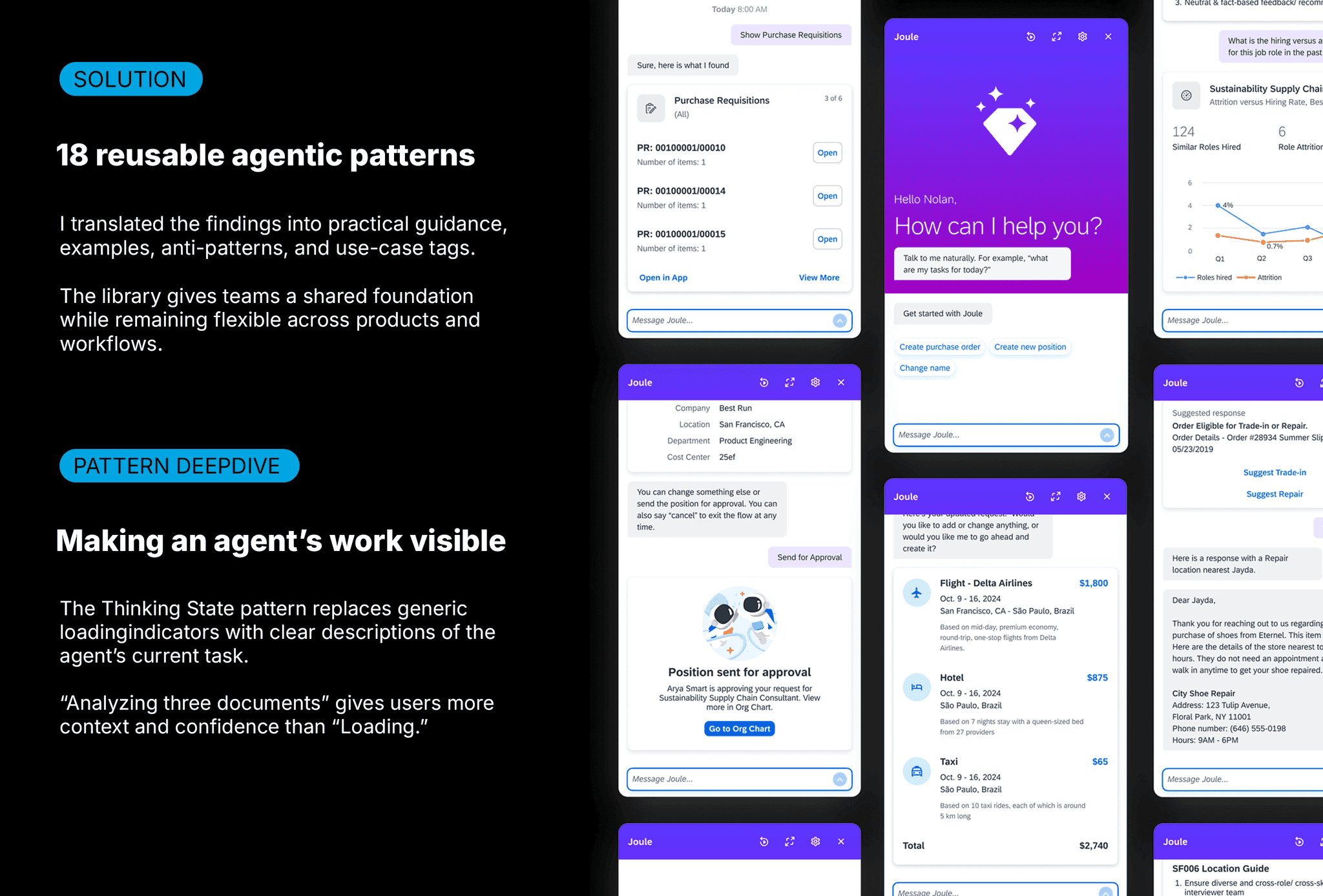
Each pattern comes with practical guidance, examples, anti-patterns, and use-case tags, giving teams a shared foundation while staying flexible across products.
For example, the Thinking State pattern replaces generic loading indicators with clear descriptions of the agent’s current task. “Analyzing three documents” gives users more context and confidence than “Loading.”
Automation
From static guidance to automated reviews.
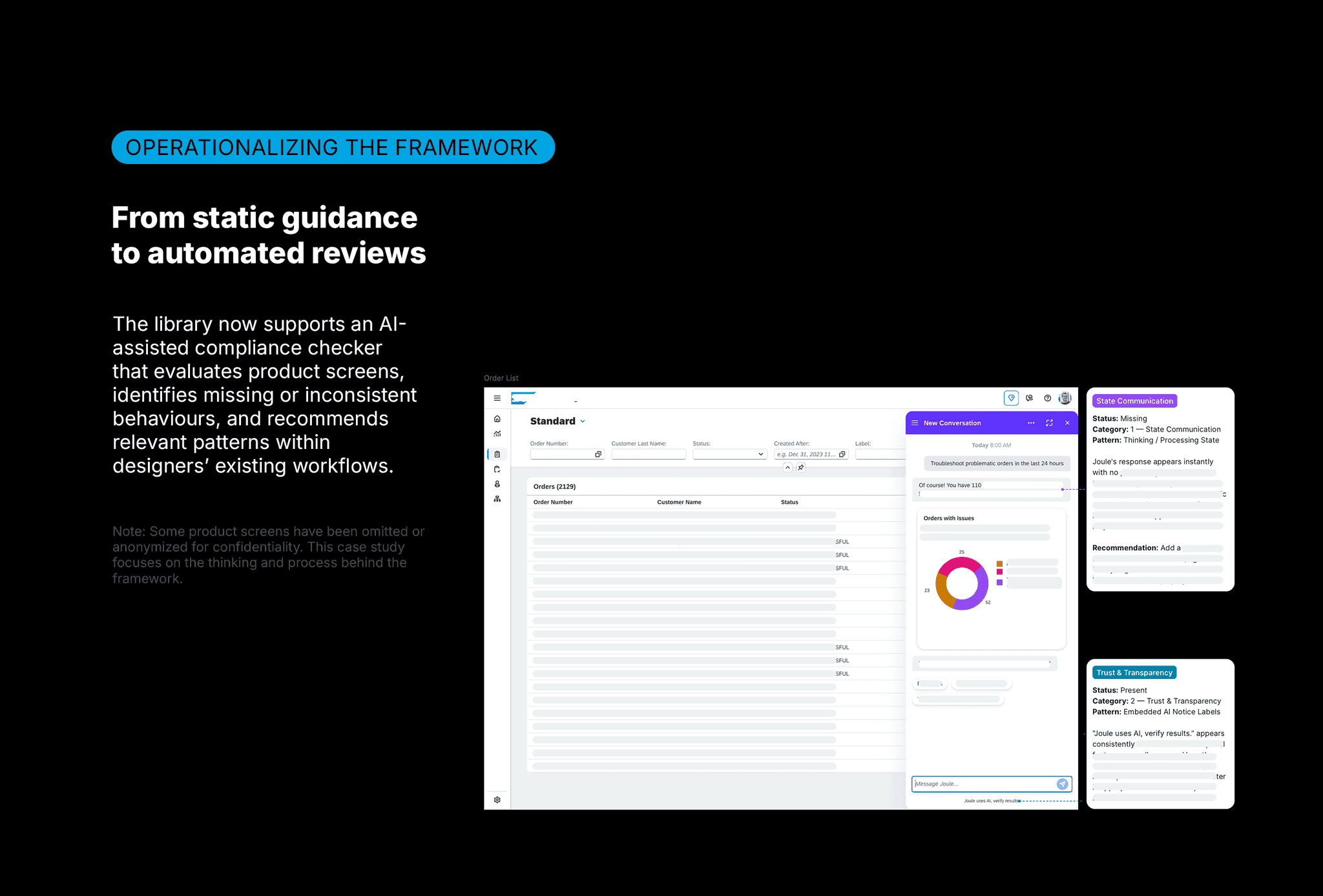
The library’s structured guidance is the knowledge base for a Figma AI skill. It evaluates product screens, identifies missing or inconsistent behaviours, and recommends relevant patterns within designers’ existing workflows.
Impact
A shared foundation for agentic experiences.
- 18 patterns across four categories
- Covers Joule and JouleWork
- Published in Figma and SAP’s UX Portal
- Presented at an international Commerce AI showcase
- Structured for automated design evaluation
Reflection
Designing beyond the happy path.
Plan for failure first
Uncertainty, recovery, and human intervention must be considered from the beginning, not added after the main experience is designed.
Shared, but flexible
The challenge was guidance specific enough to align teams, yet flexible enough for different products, workflows, and levels of autonomy.
Next
The Centre Cannot Hold